Executive Summary
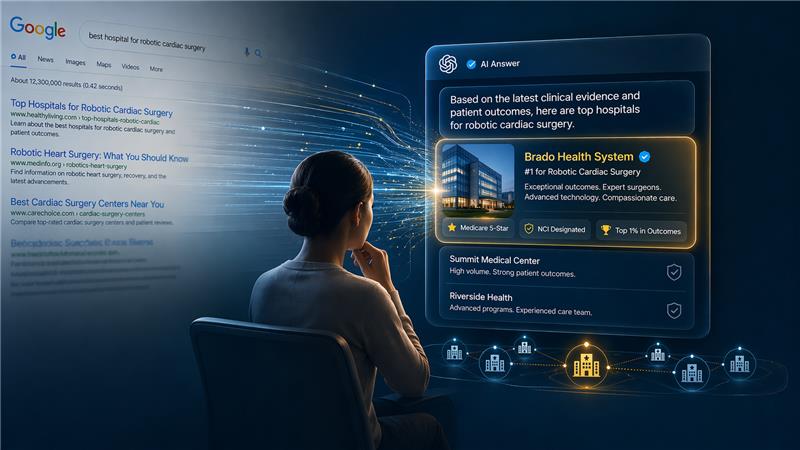
Healthcare’s front door has already moved.
Patients are no longer beginning their journey on hospital homepages or browsing provider directories. They are beginning with a question, increasingly asked inside generative AI environments like ChatGPT.
As AI interfaces reshape discovery, a new strategic question has emerged:
What happens if advertising enters the answer?
Before exploring implications, it is essential to establish the current reality:
Healthcare brands cannot advertise inside ChatGPT today.
There is no keyword auction platform.
There is no sponsored placement marketplace.
There is no mechanism for health systems to purchase ads within ChatGPT responses.
Visibility inside generative AI environments is currently earned, not bought. And that reality fundamentally reshapes how healthcare marketers must think about authority, media, and trust.
The Shift from Search Results to Synthesized Answers
Traditional paid search operates within a list-based interface. Ads appear above or below organic results, and users compare links. Generative AI replaces that list with a constructed response.
When a patient asks:
- “Should I go to urgent care for chest pain?”
- “What are the symptoms of a stroke?”
- “Where can I get a mammogram near me?”
They receive a synthesized answer, not a page of links.
In this environment, visibility works differently:
- There is no position #1.
- There is no impression share.
- There is no paid override.
There is only inclusion — or absence.
If a health system is not represented in the answer, it is not present in the patient’s early consideration set.
You Cannot Buy Your Way In
Unlike traditional search engines, where paid media can compensate for weaker organic performance; generative AI environments do not currently allow healthcare organizations to “buy” visibility.
Inclusion in answers depends on:
- Medical credibility
- Clear authorship and review signals
- Structured data integrity
- User personalization layer
- Consistent brand presence across trusted digital sources
- Original, authoritative content
If a system is absent from generative responses, increasing paid media spend will not solve the problem. The solution is authority building.
This is not a minor operational difference. It represents a structural shift in marketing leverage.
Why Advertising in AI Still Matters Strategically
Although healthcare brands cannot advertise inside ChatGPT today, the topic remains strategically critical for three reasons.
1. Monetization Across AI Interfaces Is Inevitable
As AI becomes the primary interface for discovery, monetization models will evolve. Other digital platforms have consistently introduced sponsored placements once scale and adoption were established.
Healthcare leaders must be prepared for the possibility that contextual, question-based advertising formats emerge in generative environments, even if the regulatory framework evolves cautiously.
2. Authority Will Determine Eligibility
If advertising becomes available in high-trust categories like healthcare, it is unlikely to operate as an open auction free-for-all.
Brands that lack credibility signals, medically reviewed content, and structured authority will face heightened scrutiny.
In other words: Even if paid placement becomes possible, only trusted brands will be viable participants.
3. The Paid–Earned Divide Is Collapsing
In traditional digital marketing, SEO and paid search were parallel workstreams.
In generative AI environments, authority influences both.
If AI models consistently describe a system as credible, comprehensive, and accessible, that positioning strengthens downstream paid performance across search, display, and social channels.
Generative authority becomes a force multiplier.
Trust Is the Primary Currency
Healthcare is uniquely sensitive.
Health decisions are emotional, urgent, and high-stakes. Generative AI systems already apply stricter thresholds to medical topics because misinformation carries real-world risk.
If advertising eventually appears within or alongside AI-generated guidance, the environment will be inherently trust-weighted. Patients will subconsciously ask:
- Why is this appearing here?
- Is this clinically aligned?
- Is this helpful — or promotional?
For healthcare organizations, misalignment could erode credibility quickly. This is not a performance marketing sandbox. It is adjacency to clinical reasoning.
The New Strategic Model: Authority First, Amplification Second
Healthcare marketers should prepare for an AI-driven ecosystem built on two sequential layers:
Layer 1: Earn Inclusion
This requires:
- Medically reviewed, original content
- Generative Engine Optimization (GEO) practices
- Structured data clarity
- Consistent provider and service representation
- Real-world prompt testing and monitoring
In generative discovery, visibility is binary. You are either in the answer, or you are not.
Layer 2: Prepare for Responsible Amplification
If and when paid placements emerge, their performance will depend on:
- Question-level intent alignment
- Clinical sensitivity
- Geographic relevance
- Seamless handoff to guided engagement experiences
Healthcare systems should not prepare to “buy ads in ChatGPT.” They should prepare to amplify trust, if amplification becomes available.
Measurement Will Change
Even without in-platform advertising, generative AI is already disrupting traditional KPIs.
- Traffic has declined as AI answers absorb early-stage education.
- Click-through rates have fallen.
- Organic rankings may matter less than inclusion frequency.
Because of this, marketing leaders must begin tracking:
- Inclusion in generative responses
- AI-described positioning and sentiment
- Prompt-level visibility
- Downstream conversion quality from AI-educated patients
This represents a shift from volume metrics to authority metrics. Or as we like to say, from “Clicks to Credibility”.
The Real Risk: Assuming Paid Can Fix Generative Invisibility
The most dangerous strategic assumption healthcare leaders could make is this:
“If advertising becomes available, we’ll just increase spend.”
That logic belongs to the click-based era.In AI-driven discovery, weak authority cannot be offset by higher bids.
If a health system does not show up organically in trusted generative responses, paid placement, even if introduced , will operate on unstable ground.
Authority is the prerequisite. Not the add-on.
Conclusion: The Answer Is the New Front Door
Healthcare brands cannot advertise in ChatGPT today. But the interface where patients begin their journey has already changed.
The front door is no longer a homepage. It is no longer a list of links. It is a synthesized answer to a vulnerable question.
Marketing leaders must focus on:
1. Being included in that answer.
2. Being described accurately within it.
3. Building trust before amplification becomes possible.
In the AI-first era, growth will belong to health systems that earn authority early, guide patients clearly, and treat generative environments not as ad inventory, but as moments of care.
Paid media may eventually enter the answer.
Trust already has.