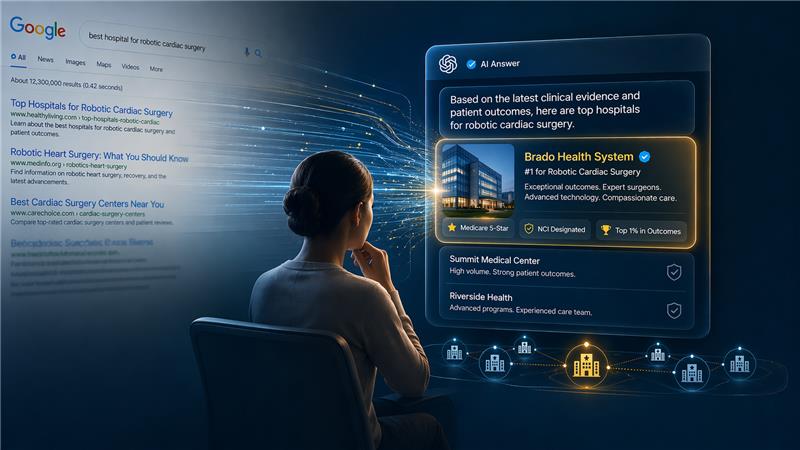
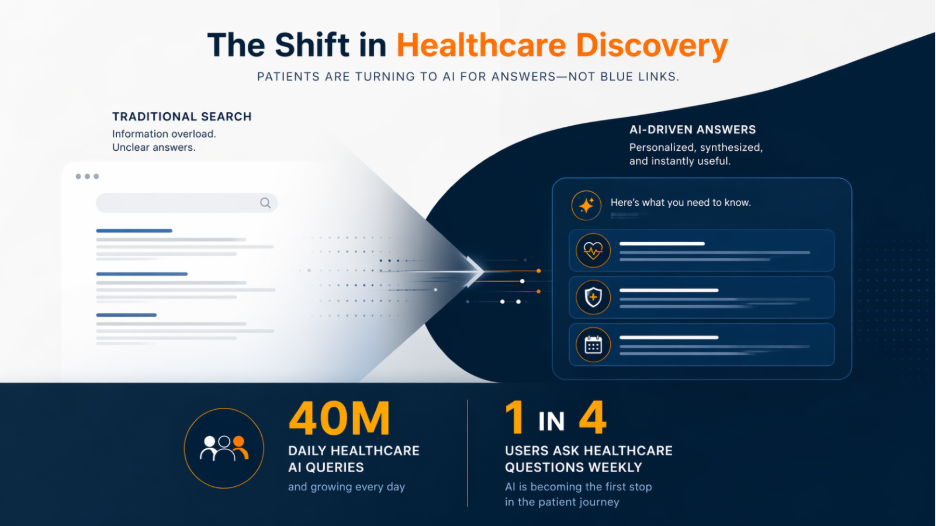
Of the more than 800 million regular users of ChatGPT, 1 in 4 submits a prompt about healthcare every week — and more than 40 million turn to ChatGPT every day with healthcare questions. (Fierce Healthcare) That's not a niche behavior. That's a mainstream behavioral shift happening faster than anything the healthcare industry has seen since the rise of the smartphone.
If 40 million patients asked a stranger on the street for health advice every day, your health system would have a crisis communication team. So why isn't your marketing team treating AI the same way?
Why Should Health Systems Invest in GEO? The Zero-Click Reality
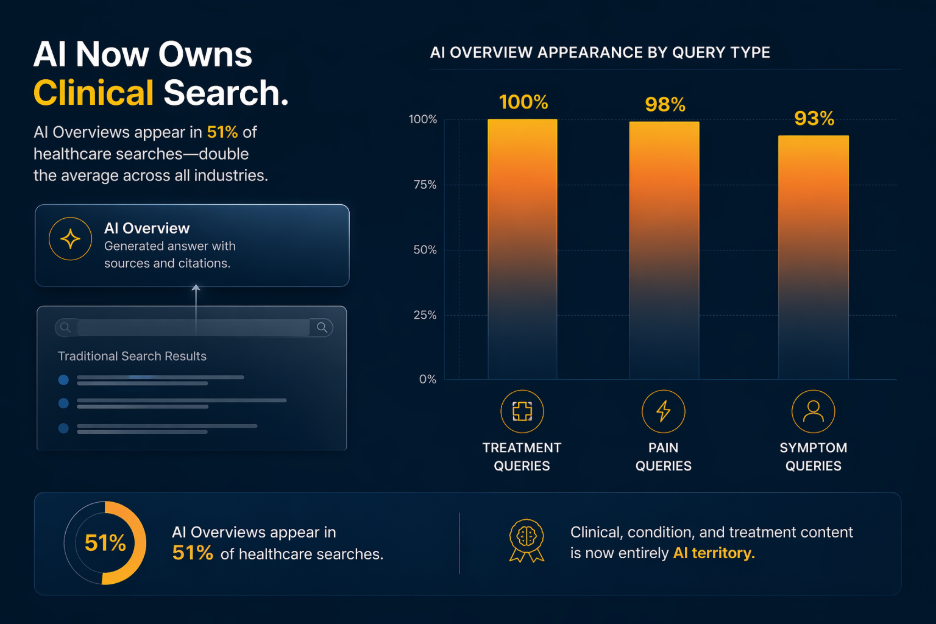
In an analysis of over 130,000 health-related search queries, AI Overviews now appear in 51% of healthcare searches, double the average across all industries.( WebFX) That's not a blip. Healthcare is the vertical most aggressively colonized by generative AI.
Treatment queries now trigger AI Overviews 100% of the time. Pain-related queries: 98%. Symptom queries: 93%. Clinical content is now effectively AI territory. (BrightEdge)
Patient Trust Changes for AI-Generated Answers
What makes GEO in healthcare genuinely different from every other industry is the trust asymmetry. 41% of users believe that AI-generated answers are based on content quality, meaning when patients see a health system cited, they assume that citation is a mark of accuracy and credibility, not an algorithmic accident. (Aha Media Group) Your brand reputation is now being built (or destroyed) inside AI interfaces before patients ever visit your website.
When your health system's information is synthesized by an AI into a patient's "answer," who controls the narrative? And if you haven't optimized for that moment, who is? If a competitor's clinical content is what AI cites when a patient asks about your specialty, do you even know?
The First Mover Advantage for GEO is Real
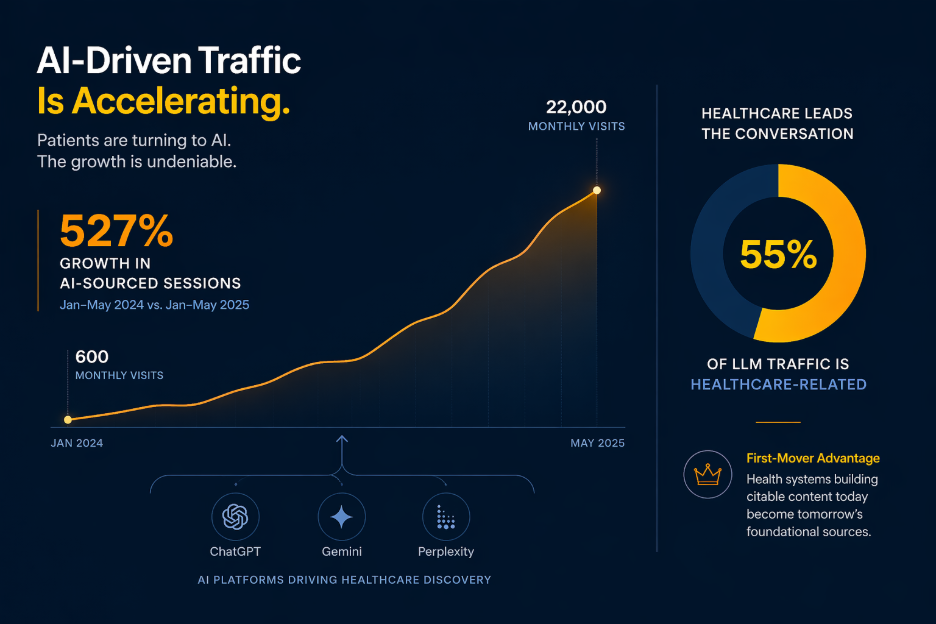
AI-sourced sessions from platforms like ChatGPT, Perplexity, and Gemini surged 527% year-over-year between January–May 2024 and the same period in 2025, with healthcare accounting for 55% of all LLM-sourced traffic. (Valtech) The health systems building citable content libraries right now are the ones whose brands will be embedded in the foundational knowledge of future model iterations.
OpenAI made its healthcare ambitions explicit in January 2026, launching ChatGPT for Healthcare at leading institutions including AdventHealth, Baylor Scott & White, Boston Children's Hospital, Cedars-Sinai, HCA Healthcare, Memorial Sloan Kettering, Stanford Medicine, and UCSF, with answers grounded in millions of peer-reviewed research studies, public health guidance, and clinical guidelines, with clear citations including titles, journals, and publication dates. (OpenAI)
Anthropic followed days later. Eric Kauderer-Abrams, head of biology and life sciences at Anthropic, stated directly: "Anthropic is a very natural fit for the healthcare and life sciences world because our identity as an AI company is built around safety and responsibility and rigor and reproducibility — and these are all the central tenants of the healthcare and life sciences industries." (Fierce Healthcare) Health systems like Banner Health and Stanford Healthcare are already integrated.
The message from both AI leaders is unambiguous: they are actively building AI systems that synthesize clinical information and recommend health systems to patients. The only question is whose content they'll cite.
Capturing the High-Intent Patient as Loyalty Fades
80% of consumers aged 18–34 embraced AI healthcare solutions in 2024, compared to less than 60% of those over 55. (Pinnacle Pursuit SEO) These are the exact patients who have no generational loyalty to a health system. About 7 in 10 health-related conversations with ChatGPT take place outside typical clinical hours, suggesting users are looking for information when they can't readily access their providers. (Healthcare Dive) The health system that becomes the AI's trusted source is filling the clinical access gap, and those patients will remember who helped them at 11pm when their child had a fever.
Your health system has spent decades building a reputation for clinical excellence. What are you doing to make sure AI knows that, and can prove it? When a patient in a rural hospital desert asks ChatGPT "what hospital should I drive to for robotic cardiac surgery," is your system the answer? If not, who is? If AI is now a primary care referral competitor, when does it show up in your patient acquisition budget?
How Health Systems Can Lead the Charge in Generative Search Visibility
Structured Data (Schema Markup) for Health Systems
The critical distinction that most healthcare marketers miss: Google has explicitly bifurcated the landscape. Local and provider-finding queries — "cardiologist near me," "dermatologist near me" — went from 100% AI Overview coverage in 2023 to 0% in 2025. Google removed AI entirely from local intent queries. (BrightEdge) Your local SEO investment is not wasted, it protects bottom-of-funnel conversion. But clinical, condition, and treatment content is now entirely AI territory, and machine-readable structured data is the price of entry.
You wouldn't publish a physician bio without a photo. Why are you publishing clinical content without the structured data that tells AI who wrote it, what they're credentialed in, and what institution backs it?
Clinical Authority as Currency in AI Generated Answers
This is where health systems have an advantage no consumer brand can replicate — and most are squandering it. Brands publishing medically reviewed articles or partnering with credible organizations are gaining visibility in both AI summaries and traditional listings. (Skai) The research-review-publish cycle that health systems already have for patient education materials is exactly the pipeline GEO requires, it just needs to be fed with intentionality.
Google's own E-E-A-T framework (Experience, Expertise, Authoritativeness, Trustworthiness) was built for exactly this moment. Health systems are, by definition, the most authoritative content creators in the healthcare information ecosystem. The irony is that most of them write like they're afraid of their own expertise.
On the misinformation risk — a counter-intuitive argument for urgency:
A Mount Sinai study and other academic research have documented systematic problems with AI-generated health information, and nearly 40% of users aren't sure how AI chooses what to show, but 41% believe AI-generated overviews are based on content quality. (ALM Corp) Here is the uncomfortable truth: if authoritative health systems don't fill the AI knowledge gap with accurate, structured clinical content, misinformation will. You are not just competing for patients. You are competing for the integrity of health information itself.
Your health system's physicians have clinical expertise that no AI can invent. Are your physician bios built to be cited by an LLM, or built to look nice on a website? When an AI gets a question about a condition your health system specializes in, is your peer-reviewed research in its training data, or is a less credible source filling that vacuum?
Conversational Content is Necessary for Future Success
The behavioral data here is striking. 32% of respondents in the 2025 Consumer Adoption of Digital Health Survey reported using AI chatbots to find health information, up from 16% just a year prior — and 64% of AI users engage with it for health questions weekly or more often. (Fierce Healthcare) These are not one-time curiosity searches. This is habitual behavior.
By mid-2025, 26% of patients reported that AI tools had directly influenced their choice of healthcare provider, placing AI on par with primary care referrals (28%) and healthcare review sites (29%) in terms of influence. (rater8) That is a staggering shift in the referral hierarchy in under two years.
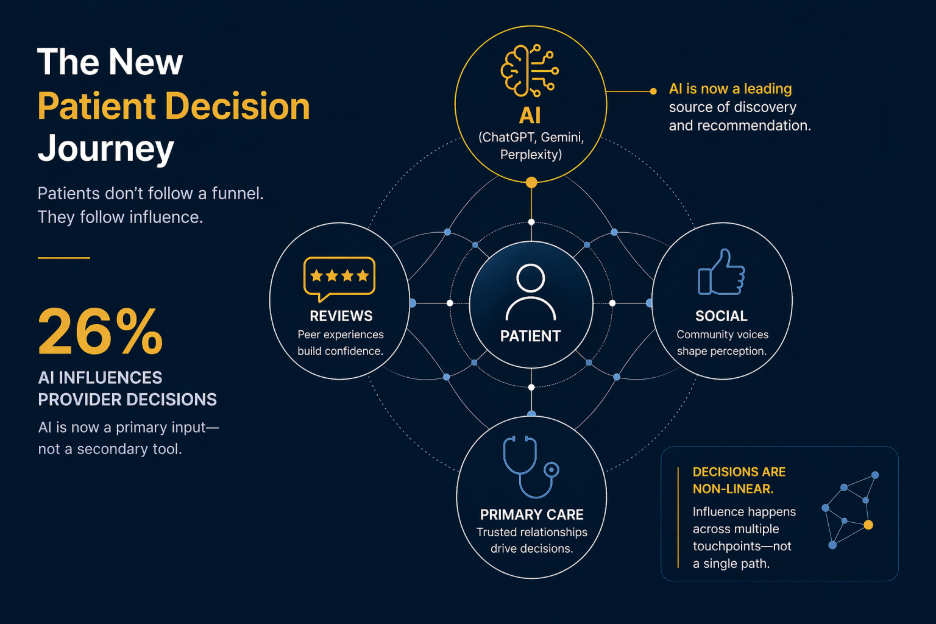
The GEO content format that wins:
Healthcare queries that are 7 words or longer trigger AI Overviews nearly three out of four times (73.9%). (WebFX) Patients are not asking "heart surgeon." They are asking, "Which hospital in my area has the best outcomes for minimally invasive heart valve surgery and accepts Medicare?" Your content must be structured to answer that question, not just rank for "cardiac surgery."
Can your website currently answer the question "What makes [Your Health System] different from [Competitor] for [specific procedure]?" in a way an AI can parse and cite? If not, your competitor's website might be the one providing that answer. If a Millennial patient treats choosing a hospital like choosing a restaurant — researching AI, reviews, and social media before booking — what does your digital presence tell them before they ever speak to a human?
The Uncomfortable Tension of GEO and Healthcare
There is a paradox at the center of healthcare GEO that no one else in the agency world is addressing honestly: Google is simultaneously the biggest driver of GEO urgency and the platform most publicly retreating from AI health answers.
On January 11, 2026, following a Guardian investigation, Google removed AI Overviews from certain health searches after finding that its AI Overviews provided health information that could mislead users. (Higoodie)
This does not reduce the urgency of GEO, it raises the stakes. Because while Google recalibrates, ChatGPT and Gemini have already become the most-used AI chatbots for health information, with 23% and 15% of respondents using the platforms respectively. (Fierce Healthcare) The patients who aren't getting answers from Google's AI are going to ChatGPT, Perplexity, and Claude. The traffic is not returning to the blue links. It's redistributing across a more complex AI ecosystem.
The brand recall problem nobody is solving: Only 24% of survey respondents could recall a brand or hospital cited in an AI response just moments after reading it. (Aha Media Group) This is the most important statistic in this entire piece. GEO visibility without brand architecture is a hollow win. Health systems cannot treat GEO as just a content strategy, it must be paired with a differentiation strategy that makes the brand memorable, not just citable.
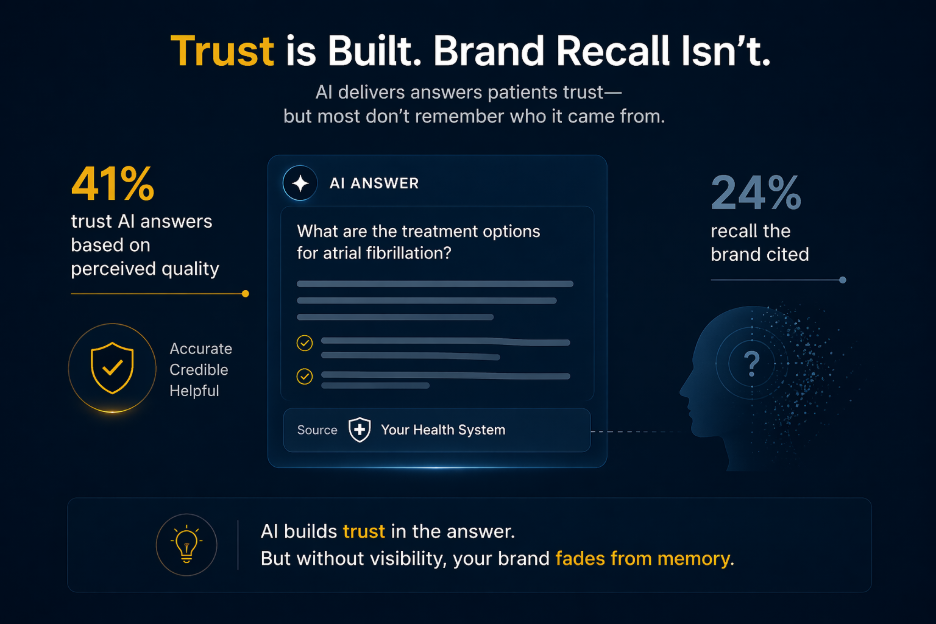
If AI cites your health system's clinical data but a patient can't remember your name five minutes later, what have you actually won? Health systems operating on a 1–2% margin cannot afford to be invisible in AI, but can it afford to be cited without being remembered? What is the brand strategy that makes GEO convert?
The Bottom Line: GEO is Necessary Today
The window for first-mover advantage in healthcare GEO is not years away, it is closing now. Some healthcare websites are already seeing more than 22,000 monthly visits from ChatGPT alone, having grown from just 600 monthly visits in early 2024. (Valtech) Those organizations didn't get there by accident. They got there by deciding early that AI citations were a strategic asset, not a marketing department side project.
The health systems that treat GEO as infrastructure, the same way they treated electronic health records or website migration, will own the AI-mediated patient relationship for the next decade. The ones that treat it as a trend to monitor will spend that decade wondering where their digital front door went.
Health systems can't afford to be invisible in AI. They can't afford to be cited without differentiation. And they're losing the generational loyalty safety net that used to forgive both. GEO is not a digital tactic. For health systems operating on 1–2% margins, in a world where younger patients are consumers first and patients second, it is a survival strategy.